


How the Aditya System Works#
The Aditya system as taught by Ernst Wilhelm is a rediscovery and reinterpretation of ancient Indian mythology, and a new way of doing astrology that has already proven to be very insightful. It provides a rich interpretive framework that promises to help us more deeply understand ourselves and others. Here I will give a more technical explanation of the fundamentals of the Aditya system and how the 84 beings work. You can find your own being activations with our Meet your Beings app.
First, how astrology works
Before we get into the specifics of how the Aditya system works, let's review how astrology works in general.
Astrology is the study of how planetary motions correspond to events. These can be world events, interpersonal events, or personal events, i.e., psychology. Some use it to determine what did happen or will happen. More recently astrology has become a means for humans to better understand themselves: why they are the way they are and the ways they can change or improve themselves.
Since we are relating the motions of the planets to events on Earth, we think about their motion in geocentric terms. Of course we know that in reality the Sun stays more or less in the same place and the Earth orbits around the Sun. But from our perspective on Earth it appears as though the Sun rotates around the Earth. Therefore, this is how we will understand the motion of the Sun and the planets in this conversation, since the Aditya system primarily relates to our life on Earth. (Of course some people do heliocentric astrology and that may have value, but not usually in terms of personal events or psychology.)
The Sun appears to make a circle around the Earth. We call this circle the ecliptic. If you took the equator and drew it in the sky, the ecliptic and the equator would be distinctly different circles which cross each other at two points. These two points are the equinoxes. When the Sun is most north of the equator this is called the northern solstice (summer solstice in the northern hemisphere, winter solstice in the southern hemisphere) and when it is most south of the equator this is called the southern solstice.
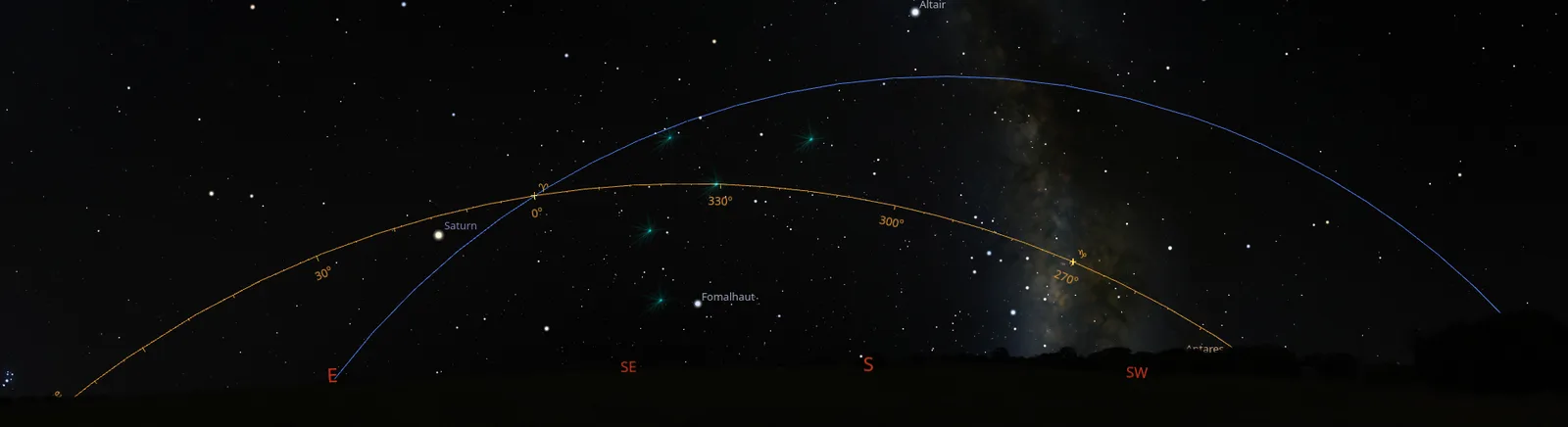
The zodiac signs are a division of the ecliptic. Since the Sun makes a circle around the Earth, the ecliptic consists of 360 total degrees. There are 12 zodiac signs, making each zodiac sign take up 30 degrees of the circle called the ecliptic.
Where the circle starts
A circle has no precise beginning. Where it starts is a choice we make.
Where does the circle start? In fact, a circle has no precise beginning, so the place where it starts is a choice we can make. In tropical astrology, we start at the ascending equinox, the place where the Sun crosses the equator moving north (the spring equinox in the northern hemisphere, the autumn equinox in the southern hemisphere). This begins the sign of Aries. In sidereal astrology, we decide where the circle starts based on the position of some star. Where we start the circle in sidereal astrology is called an "ayanamsha" and is generally thought of as being an offset from the equinox. For example, the most common ayanamsha in sidereal Vedic astrology is Lahiri ayanamsha. To find the starting point, you find the star Spica and that is the beginning of Libra. There are many ayanamshas, i.e., many places where various astrologies think the zodiac circle should start.
Where does the Aditya circle start? Firstly, the Aditya system is a tropical system. That means the start of the circle is relative to the equinoxes and solstices. However, we do not start the Aditya system precisely at an equinox. Rather, the first sign of the Aditya system, Dhata, starts 30 degrees before the ascending equinox. The reason for this is more complex than I will get into here, but the original insight came from studying the structure of the South Indian chart and Jaimini's rashi aspects. The idea itself is also corroborated by other systems, notably the Chinese lunar new year.
Thus the sign of Dhata Aditya takes up the same section of space as tropical Pisces. Aryama Aditya takes up the same section of space as tropical Aries and so on. If you are familiar with tropical astrology this might seem challenging to wrap your head around and there are many debates about the relationship between the tropical and Aditya system, or even whether we should try to relate them. My suggestion is that when you are starting to learn the Aditya system, focus only on the Adityas and don't try to relate them to tropical signs because that may cause more confusion than clarity.
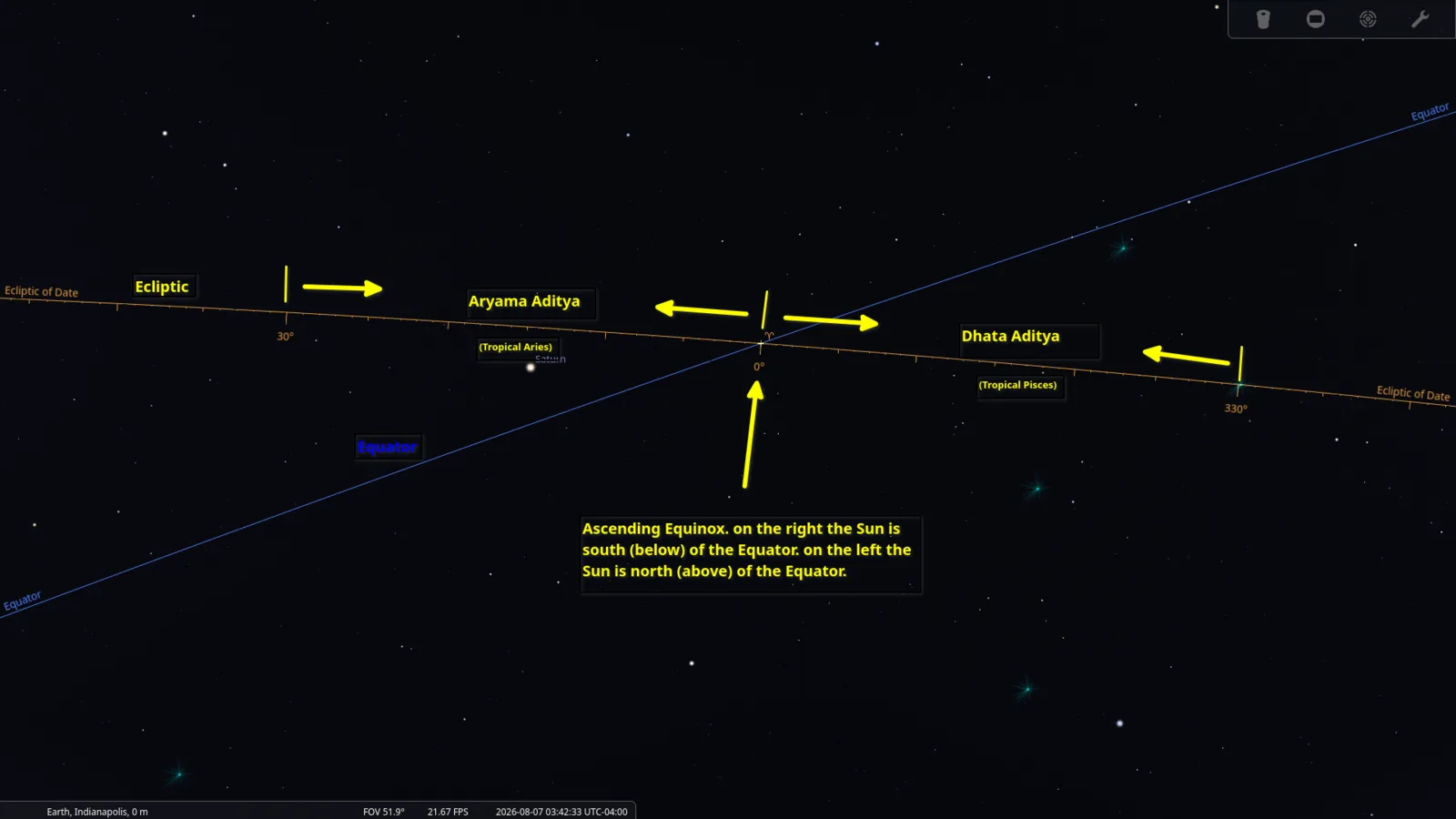
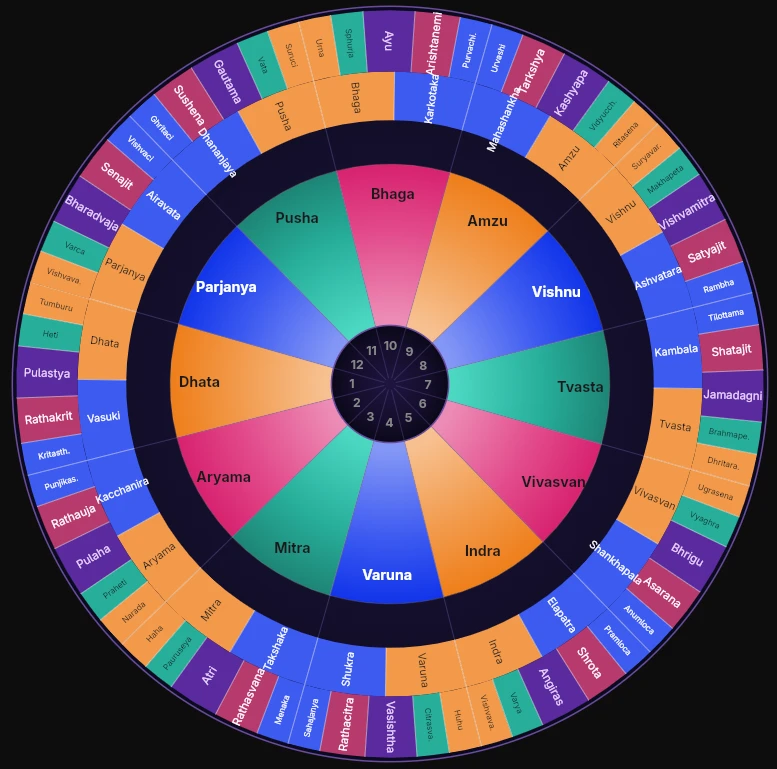
The foundation of the Aditya system is dividing the ecliptic into 12 equal portions of 30 degrees each, starting 30 degrees before the ascending equinox. Then each of the portions belongs to one Aditya, in the following order:
- Dhata
- Aryama
- Mitra
- Varuna
- Indra
- Vivasvan
- Tvashta
- Vishnu
- Amshu
- Bhaga
- Pusha
- Parjanya
Now that we understand the foundational astrology, we can look into the 84 beings themselves.
The 84 Beings
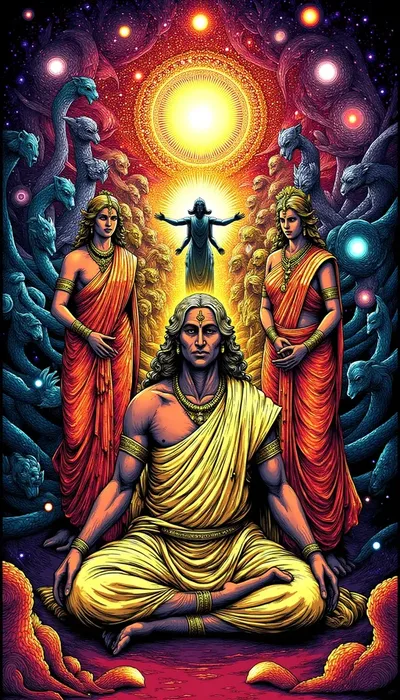
Many Puranas speak of the 12 Adityas, sons of the rishi Kashyapa and his wife Aditi. The word "aditi" means undivided, unbounded, infinite. The ecliptic itself as a circle has neither beginning nor end and thus Aditi is represented by the ecliptic itself. The word "Aditya" means "coming from Aditi". Each Aditya represents a 12th part of the circle of the ecliptic. They each partake of the infinite but since they only represent a part they are more conceivable to humans. Their purpose is to help us understand and attain to the boundless and infinite love that Aditi represents.
In the Srimad Bhagavatam, this is said of the Adityas:
Through each of the twelve months, the divinity travels along with six sets of associates, spreading virtuous intelligence everywhere, for this world and for the next. Rishis chant his glories through hymns from the Sama, Rig and Yajur Vedas. Gandharvas chant his praise and the best of apsaras dance before him. The nagas yoke his chariot and the yakshas drive the chariot from the front. The extremely powerful rakshasas push the chariot from the rear.
Translation by Bibek Debroy, page 485 of volume 3 of his translation of the Srimad Bhagavatam.
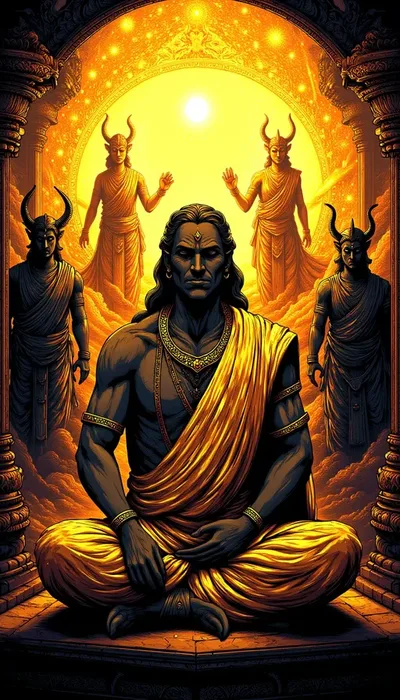
This is thus the origin of the 84 beings: each Aditya travels with 6 other beings, a rishi, a gandharva, an apsara, a yaksha, a naga and a rakshasa. With 12 Adityas this makes 84 beings in total. Earlier in the same chapter each Aditya is listed, naming the solar month that it governs and the names of the beings that travel with each Aditya.
Rishi
Pulastya
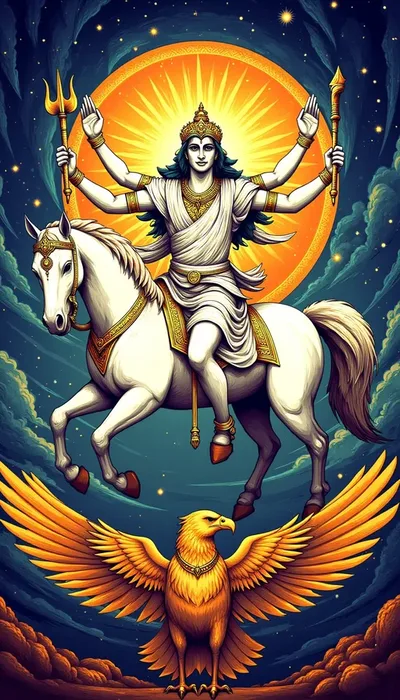
Gandharva
Tumburu
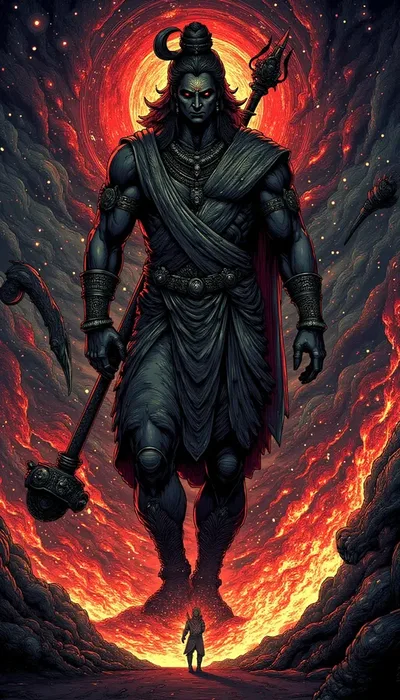
Rakshasa
Heti
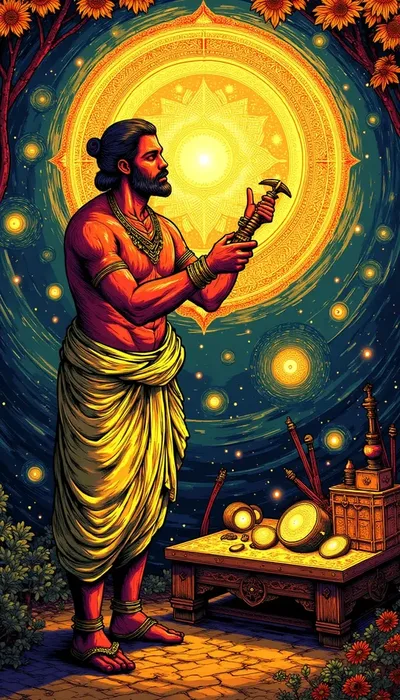
Yaksha
Rathakrit
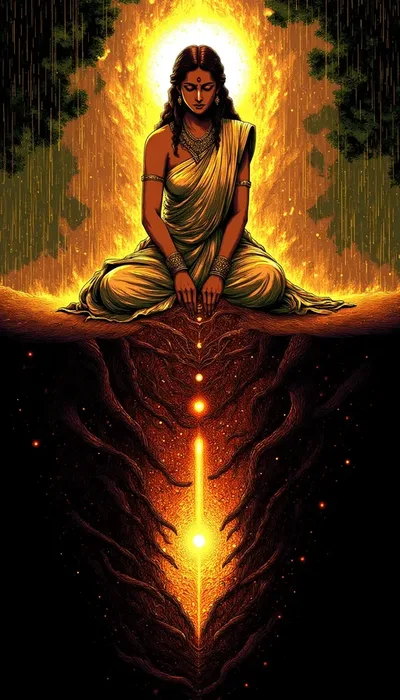
Apsara
Kritasthali
How do we determine which beings are activated?
Beings are activated by planets in the chart. This happens along three paths. Firstly, each being is "in an Aditya". Adityas in this system replace zodiac signs or "rashis" as they are often called in Vedic astrology. Each Aditya represents a certain kind of love, and each being that travels with that Aditya is responsible for fostering that love in us in a particular way, according to the talents and abilities of that type of being, and that specific being.
Level one — the Aditya
So the first level is simply a planet in an Aditya sign, which shows the general kind of love that this planet is trying to express in you and through you.
Level two — the Hora, or Soul Stance
The second level is based on the Hora the planet is in. "Hora" is actually a Greek word that gives us the word for "hour". The ecliptic takes approximately 24 hours to make one rotation around the Earth. We often measure this by the rising sign; that is, which part of the ecliptic is on the eastern horizon at any moment. Each sign (30 degree portion of the ecliptic) takes about 2 hours to rise (depending on your latitude). Thus we split each sign into 2 parts of 15 degrees each and each of these parts takes about 1 hour to rise.
Traditionally the two horas of each sign are ruled by the Sun and the Moon. For masculine signs (every other Aditya starting with Dhata) the first 15 degrees are the Sun's hora and the last 15 degrees is the Moon's hora. For feminine signs (every other Aditya starting with Aryama) the first 15 degrees are the Moon's hora and the last 15 degrees are the Sun's hora.
| Aditya | 0° – 15° | 15° – 30° |
|---|---|---|
| MasculineDhata, Mitra, Indra, Tvashta, Amshu, Pusha | Sun's hora — Aditya | Moon's hora — Naga |
| FeminineAryama, Varuna, Vivasvan, Vishnu, Bhaga, Parjanya | Moon's hora — Naga | Sun's hora — Aditya |
Planets in the Sun's hora express the Aditya's love into the world. Planets in the Moon's hora express it inwardly.
The Sun is related to the Aditya itself. The Moon is related to the Naga of each Aditya. I call the horas "Soul Stances" because they determine the particular field in which a planet works. Planets in the Sun's hora, activating more strongly the Aditya, are focused on expressing the love of the Aditya into the world. Planets in the Moon's hora, activating more strongly the Naga, are focused on expressing that love internally. The naga of an Aditya helps us to remove unconscious blocks and urges us forward with respect to learning about and expressing the love of the Aditya.
Level three — the Trimsamsha
The third level is based on a division of the sign into five parts. The technical term for the division is the trimsamsha, which means a 30th part. The trimsamsha is a varga, a "division" of a sign. The most common and famous of the vargas in Vedic astrology is the navamsha, the ninth part, which splits each sign into nine. Most vargas split each sign into the number of parts their name denotes, but the trimsamsha, or D30, splits the sign into 5 unequal parts, with each part being ruled by a particular planet. (As to why it's called the 30th part and splits into 5 unequal parts, I myself do not know.)
In the masculine Adityas (every other Aditya starting with Dhata), the division by degrees is 5-5-8-7-5, being ruled by Mars, Saturn, Jupiter, Mercury and Venus respectively. In the feminine Adityas (every other Aditya starting with Aryama), the split is reversed: 5-7-8-5-5, ruled by Venus, Mercury, Jupiter, Saturn and Mars respectively. Then each ruling planet is associated with a certain type of being: Mars is associated with gandharvas, Saturn with rakshasas, Jupiter with rishis, Mercury with yakshas, and Venus with apsaras.
| Planet | Being | Masculine Adityas | Feminine Adityas |
|---|---|---|---|
| Mars | Gandharva | 0° – 5° | 25° – 30° |
| Saturn | Rakshasa | 5° – 10° | 20° – 25° |
| Jupiter | Rishi | 10° – 18° | 12° – 20° |
| Mercury | Yaksha | 18° – 25° | 5° – 12° |
| Venus | Apsara | 25° – 30° | 0° – 5° |
In the Meet your Beings app the upper-panel "Your Beings" refers to these beings activated by a planet's trimsamsha.
By looking at the hora 24 possible beings are activated, either an Aditya or a Naga, and by looking at the trimsamsha 60 possible beings are activated, which gives a total of 84 beings.
To find which being a planet activates we determine which trimsamsha that planet falls in. If the planet falls in the first 5 degrees of a masculine Aditya, then we find which gandharva travels with that Aditya, and that is the specific being this planet activates.
A worked example
Say the Sun sits at 46° of ecliptic longitude — that is, 16° of Mitra Aditya.
Aditya
Mitra
The sign. The kind of love this planet is here to express.
Soul Stance
Takshaka
16° is the second half of a masculine sign — the Moon's hora. The work turns inward.
Trimsamsha
Atri
16° falls in Jupiter's trimsamsha (10°–18°), which activates the rishi.
So in such a chart the Sun would be activating Mitra Aditya with a focus on the internal work of removing blocks, due to being in the Moon's hora and activating the Naga being. And it would be focused on working with the love of Mitra through truth and wisdom, due to being in Jupiter's trimsamsha, activating the rishi.
Putting it together
So there are really three levels of being activations: the most broad is the sign activation. Every planet in an Aditya is fundamentally relating to the love and purpose of that Aditya. Planets in the Sun's hora are doing this more externally. Planets in the Moon's hora are doing this more internally. Then the trimsamsha being gives even more detail how this planet is working. Each of the individual beings has its own mythology and this gives much information about how that planet is working. The state of the planet itself also allows us to understand how well that being is working: whether it is doing its job well and focusing on its proper pursuits, or whether it has an unhealthy posture and is causing you more problems and thus needs to be healed.
The following image shows the circle of the ecliptic and how it is divided among these three layers. The innermost is the 12-fold Aditya division. The second layer is the 24-fold Soul Stances division. The outer ring shows the 60-fold division of signs in trimsamshas. Each section contains the name of the being activated in that portion of space.
Want to see your own? Meet your Beings — enter your birth data and the chart will show you which of the 84 are awake in you.